
Today, around 62 million Americans tune in to their favorite podcast regularly. With a wide array of categories—ranging from news, education, comedy, true crime, and anything in between—podcasts are increasingly becoming the number one media that consumers use to stay informed, learn a new skill, laugh, or just hear a damn good story.
And, of course, hear advertisements.
As with any media consumption, there is inherent ad consumption. Yet, only recently has podcasting been seen as a desirable advertising media. The rise of podcasting and its unique platform has shaped how hosts and listeners connect and how advertisers, in turn, leverage their listeners into customers.
SNAPSHOT OF A RISING MEDIA
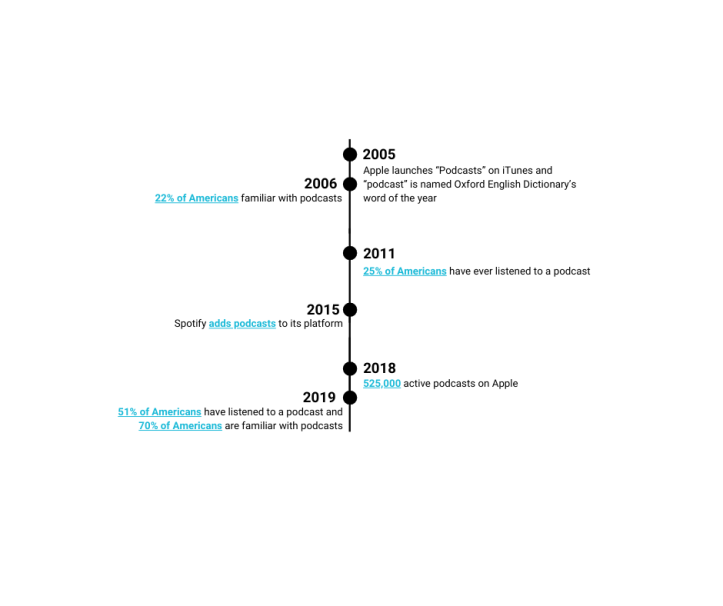
For the past decade, podcasts have steadily increased in popularity. However, the last few years have seen especially noteworthy growth. With 33% of the US population tuning in monthly, more than 700,000 million podcasts on Apple, and 29 million podcast episodes, podcasting is a hotbed of consumers for every genre of interest listed across Apple Podcasts and Spotify, the two largest platforms for unique podcast downloads.
WHERE CONSUMERS ARE LISTENING
According to The Podcast Consumer report, consumers are listening to podcasts while driving, walking around, working out, at home doing chores, at work, and while commuting on public transportation. In general, podcast listening occurs in motion, while on the go or performing other tasks.

GAINING POPULARITY & LISTENERS
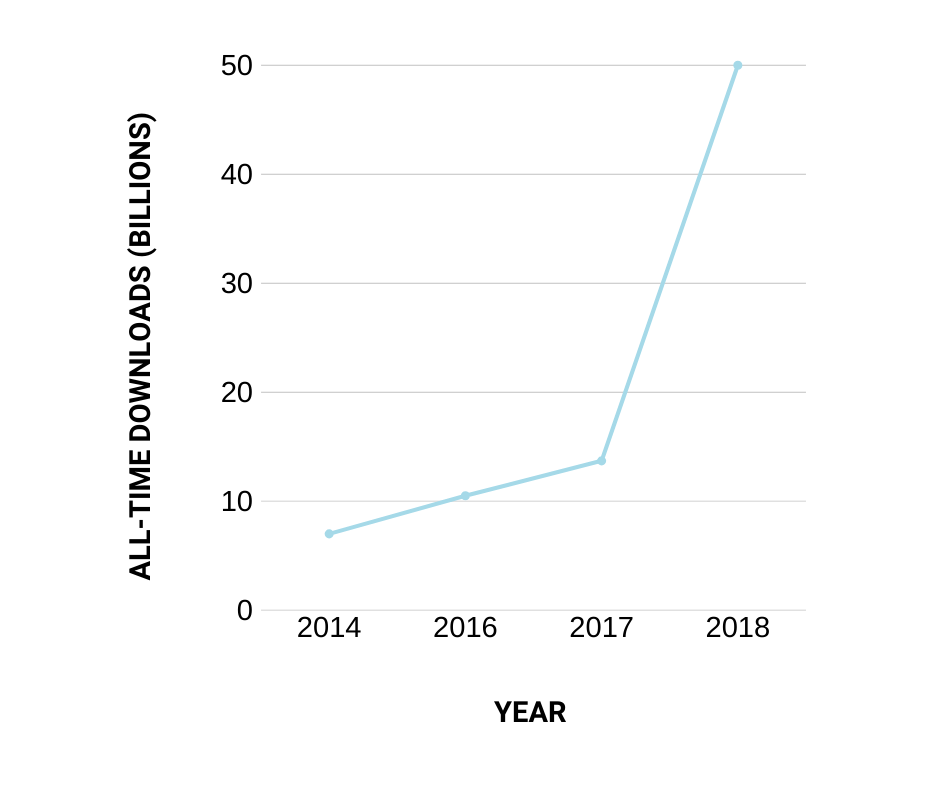
The number of podcast downloads has grown rapidly in the past six years. According to FastCompany, the number of podcast downloads on Apple and iTunes grew steadily from 2014 to 2017, where it saw a sharp increase in downloads, leaping from 13.7 billion to over 50 billion all-time downloads.
All-time podcast downloads by year
Why this major spike in podcast listening? There are a few key developments attributed with the rapid growth of podcast listeners including:
- More smartphone users
- More platforms like Spotify adding podcasts to their offerings
- More celebrities, YouTube stars, and other digital influencers hosting podcasts
- More major media companies creating podcasts or podcast networks (NPR, New York Times, CNN, Washington Post, Wall Street Journal, ABC News, iHeartRadio)
As listenership continues to grow and become more diversified, so, too, does the range of content. A quick scan of Apple’s Podcasts Top Charts shows a wide array of genres and household media names stippling the charts—Joe Rogan, Rachel Maddow, Trevor Noah, Brené Brown, Dr. Phil, Emma Chamberlain, and Will Pharrell (as his character Ron Burgundy)—to name a few. There’s a little something for everyone.
And everyone is listening.
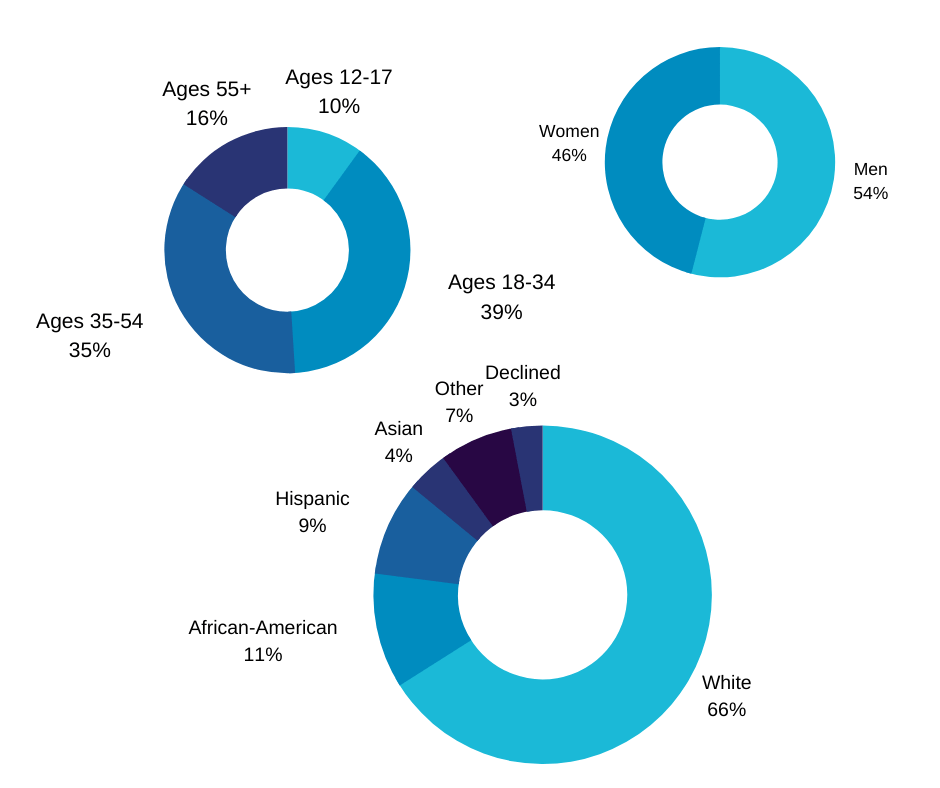
Monthly podcast consumers by age, gender, race
AD SPONSORSHIP, REVENUE, AND CONVERSIONS
The increasing popularity of podcasts has generated interest from advertisers or, as they’re called in the podcasting world, sponsors.
Podcast “sponsors” tend to be direct-to-consumer (D2C) ads—this can range from companies like HelloFresh or Madison Reed to Netflix Original movies to Fox television shows. Because podcast ads have no way to directly send listeners to a landing page, the medium presents a few purchasing barriers. Typically, the podcast host will rattle off a short URL or the company name, along with a code listeners can use to get a discounted product or service. When listeners-as-customers use that code (or designated URL) at checkout and complete a purchase, it can be tracked as a successful conversion. But, because individuals are often consuming podcasts while multitasking (e.g., while at work, at the gym, driving), this indirect format presents another purchasing barrier. The URL or discount code needs to be easy to remember and memorable—if it’s going to be remembered at all. Consequently, ad scripts tend to focus on snappy copywriting, keyword repetition, and using a code that features some variation of the podcast or host’s name.
And, not only is it hard to track successful conversions, but the average rate for impressions (calculated in CPM or cost per mille/1,000 impressions) exceeds any other new digital media platform. Twitter, LinkedIn, Facebook, Instagram, or YouTube all average in under $10/CPM, while the average industry rates for podcast ads are a staggering $18/CPM (30-second ad read) and $25/CPM (60-second ad read).
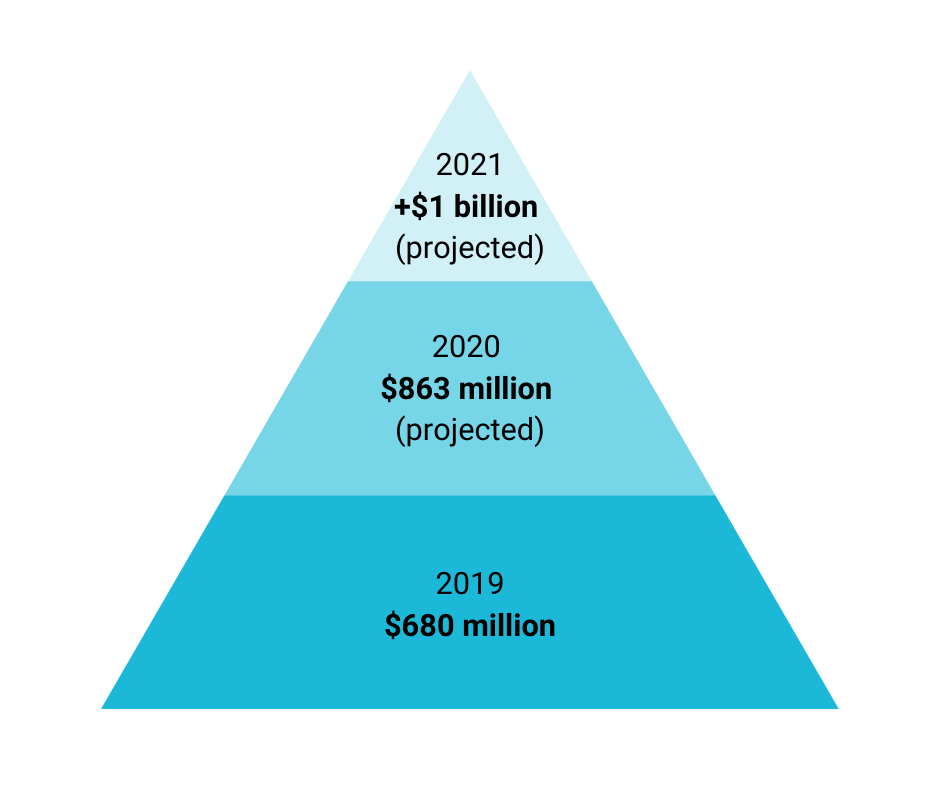
Yet, in spite of the platform’s purchasing barriers and the premium price for listeners, podcast sponsorships continue to pique advertiser interest. In 2019, $680 million was spent in podcasting ad revenue and that number is projected to climb to over $1 billion by 2021.
So, why all this ad spend if impressions are so expensive and it’s hard to test their success? Because, for all their pricey problems, podcast ads work.
WHY PODCAST ADS ARE SO SUCCESSFUL
In a 2016 study of podcast advertising, podcast listeners were 65% more willing to consider purchasing products or services that advertised on a podcast they listen to—and purchase they did:
- 45% visited a sponsors website
- 28% used a promotional discount code mentioned in the podcast
- 27% watched a television show
- 26% saw a movie
- 25% purchased a product or service
To put it mildly, in official advertising terms, those are damn good conversion rates.
What makes the podcast platform so uniquely different from its digital media counterparts—and why ads on the platform are so successful despite purchasing barriers—is highly engaged and active listeners who trust their hosts.
Hosts don’t just speak to each other or at the listener, they speak to the listener. Podcasts occur in intimate spaces (directly in your ear, in your home, in your car). These spaces are typically reserved for ourselves or loved ones. Yet, once or twice a week, a podcast host fills that space and thus creates a projected closeness that cultivates trust and loyal fans. And, when it comes to the ad read itself, hosts often speaking in their own voices—deftly infusing brand talking points with their personal opinions or sense of humor.
In effect, podcasts offer the most intimate ad experience for a media consumer.
Instead of a mass-marketed ad you can tap through quickly on Insta stories or the 120-second break in your television show reserved for using the restroom or getting more snacks, it is a quasi-friend offering you 10% off Squarespace when you use their code, PODCASTHOST10 at Squarespace.Com.
THE FUTURE OF PODCASTING ADS
+ Continued increase of listenership and dedicated ad revenue
+ More interest in podcast backlog ad space
+ Changes to attribution tracking
As most research indicates, podcasting listenership will only continue to grow and, along with that, ad revenue. Why? Hosts and listeners forge a unique relationship and thus create a more intimate ad experience. Podcasts are also a more durable media for advertising—unlike other digital media platforms in which ads compete for space in algorithmic news feeds.
Not only are podcasts a durable media, they’re scaling—rapidly. What makes the ad space so unique for podcasts is not only the intimate experience but also that their entire audience (both “rookie” and “veteran” listeners) and catalog (old and new episodes) are active consumers and ad space. Both rookie and veteran listeners will tune in for the new weekly or bi-weekly episode but will also listen to ‘backlog’ episodes. Therefore, the original ads that aired 3-months ago can be swapped out in editing whenever a contract expires and still reach a sizable listener base.
Even with the impressive conversion rates, the success tracking of podcast ads needs to become more sophisticated. Even though research indicates that listeners are learning about products or services through podcast ads, they are not always being accredited or tracked properly. As the advertising interest continues to grow, so too will the interest in developing more accurate ways of measuring how well Squarespace does on your favorite show.
THANK YOU FOR LISTENING AND THANK YOU, SPONSORS.
This podcast factsheet was brought to you by COVID-19 anxiety and my love for writing podcast ads. Want 20% off your next doomsday purchase from Amazon? Just use code ANXIETY2020 to get 20% off your next bulk order of toilet paper on Amazon. That’s ANXIETY2020 for 20% off. Thank you for listening, and thank you, sponsors.
 Crystal Abing
[…] This is understandable—podcast ads are relatively new. It’s hard to find hard and fast rules for podcast ads because there really are none. That’s the fun of them, and the downfall of them. Luckily, I’ve written you an overview of podcasts and why they’re so successful. […]
LikeLike